The First Return: What Oui Capital’s exit from Moniepoint revealed about conviction, patience, and what it really takes to build a lasting VC franchise in Africa
2026-09-09
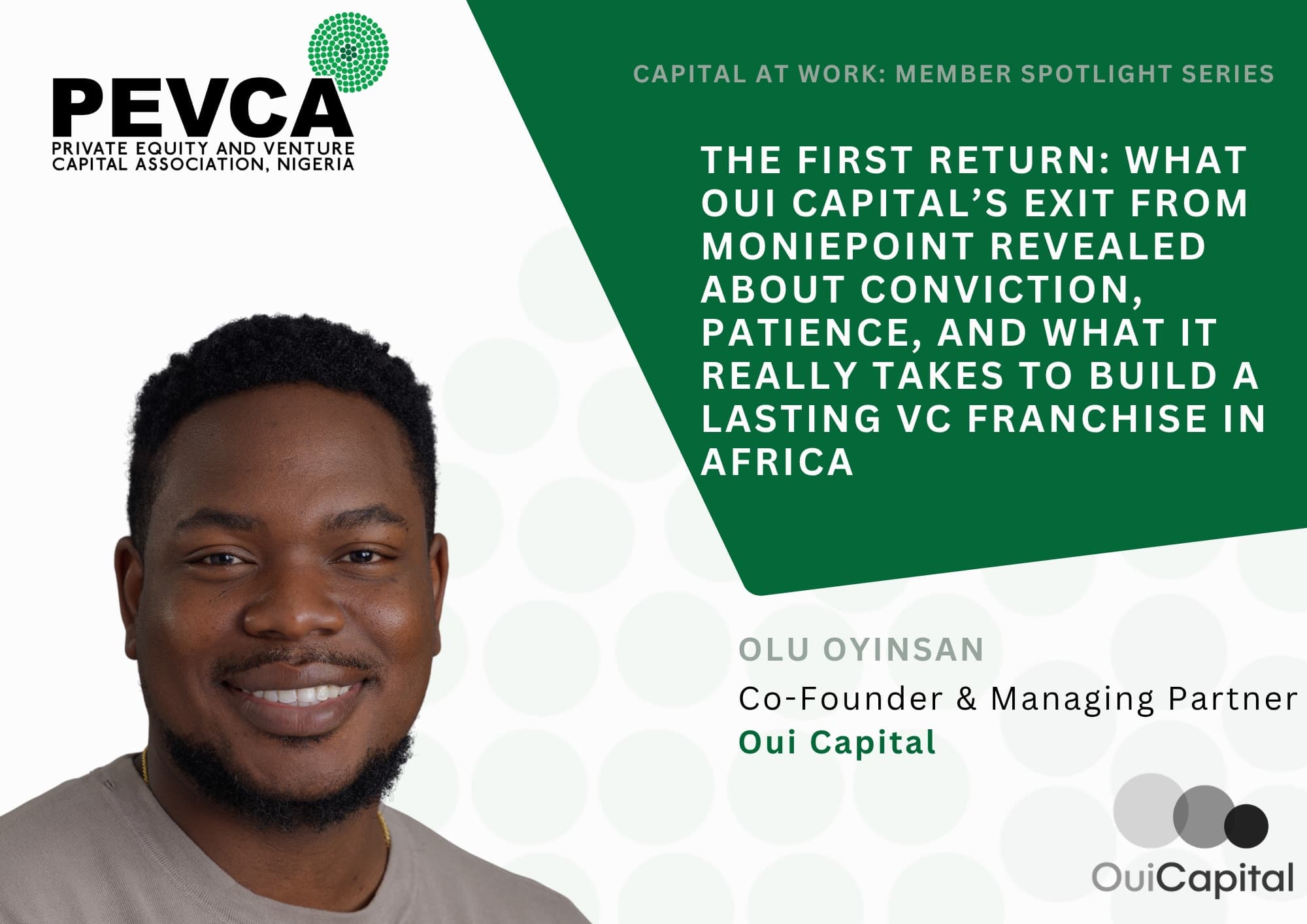
In this edition of Capital at Work, we turn to Oui Capital — and a milestone that, quietly, changed what is possible in African venture capital.
In early 2025, Oui Capital converted a $150,000 seed investment in Moniepoint into $8 million, returning their debut fund twice over and becoming the first Africa-focused VC fund to fully return a 2019 vintage. Moniepoint is now Nigeria's largest merchant acquirer and a confirmed unicorn. The return was historic. But it was also, as Olu Oyinsan is quick to point out, just one of 22 investments.
In this feature, Olu Oyinsan, Co-Founder and Managing Partner at Oui Capital, reflects on what the firm has actually built — the conviction process behind each bet, the discipline of holding through years of naira volatility without blinking, and the 21 portfolio companies that don't make the headlines but tell the fuller story of how Oui Capital invests. He also looks ahead: what Fund III demands now that the proof of concept exists, what African VC's liquidity problem really requires, and what he wishes someone had told him earlier about building companies through a market as unforgiving and rewarding as Nigeria's.
Read the interview below.
Q1. You’ve backed over 22 startups across Africa. Moniepoint gets the headline, but what’s a portfolio company that doesn’t get talked about nearly enough — and what does it tell us about how you actually pick?
Olu Oyinsan: Moniepoint gets the headline for obvious reasons and because the outcome is impressive. But from a portfolio-construction perspective, Oui Capital Fund I was fortunate to invest in several winners.
We recorded another exit from AMOpportunities, a US-based healthcare workforce platform we backed, that was acquired by a private equity consortium, generating a realised exit and returning capital to our Limited Partners — something we are also very proud of.
Beyond these early exits, we’ve invested in several promising companies across the African continent that are scaling very well, including Duplo, Akiba Digital in South Africa, and leading chemical marketplace Matta, to name a few. We are extremely proud of what Moniepoint has achieved, but our returns and fund performance have come from a diversified pool of great entrepreneurs and companies.
We are looking for founders with the capacity to build durable enterprise value in large, structurally important markets.
Q2. You’ve now returned the fund. Most GPs in Africa haven’t had that conversation with LPs yet. How has it changed the dynamic going into Fund III — what do LPs ask you now that they never asked before?
OO: The most important change is that realised returns move the conversation from narrative to evidence.
The quality of the LP dialogue has changed because what matters most to many investors is net performance.
A good track record changes the conversation with LPs and puts you in a better position to negotiate terms. Strong outcomes across the portfolio — both realised and unrealised —
provide evidence of disciplined deployment, sound underwriting and effective portfolio construction. Some LPs are less concerned with which individual company generated a particular exit than with whether the manager has demonstrated the ability to allocate capital successfully and produce returns that are compelling relative to the market.
Q3. Early-stage investing in Nigeria means betting on founders before almost anyone else will. What does your conviction process actually look like — and how has it evolved across your years of doing this?
OO: At the early stage, conviction is rarely a function of having more information. It comes from having a differentiated interpretation of incomplete information.
Francesco and I came into investing as entrepreneurs rather than traditional fund managers. That shapes our process. We spend significant time developing a proprietary view of a market, identifying the structural bottlenecks that will matter over a five- to ten-year horizon, and understanding where technology can create operating leverage before we begin evaluating companies.
We are not simply asking whether a startup is growing. We are asking whether the company is attacking a sufficiently large pain point, whether the market is structurally underpenetrated, whether the business can develop a defensible data or distribution advantage, and whether the unit economics can improve materially with scale.
That was true with Moniepoint. When we met the team, they had the technical depth, execution velocity, and customer proximity to address a fundamental friction in digital transactions.
At the pre-seed and seed stage, we are underwriting the probability distribution of future outcomes like founder quality, speed of learning, market expansion, product velocity, capital
efficiency, and the potential to become a category leader. We are looking for situations where the downside is bounded by disciplined entry valuation and ownership, while the upside is genuinely venture-scale.
Q4. African VC has a liquidity problem that goes beyond any single exit. From where you sit, having built and partially exited a portfolio, what structural change would most meaningfully improve exit conditions for the asset class?
OO: The African venture market does not need more capital for the sake of more capital. It needs more evidence of attractive, risk-adjusted returns.
Liquidity is ultimately downstream of performance. If venture consistently generates compelling net IRRs, strong DPI and credible cash-on-cash multiples, capital will follow. That is how markets deepen. Secondary liquidity, strategic acquisitions, growth capital and public-market participation all become more viable when buyers believe the underlying asset class produces durable enterprise value.
The priority should therefore be underwriting and building companies that can survive multiple financing environments, reach meaningful scale and generate strategic or financial value for acquirers. That requires more discipline around entry valuations, ownership targets, follow-on reserves, burn multiples, contribution margins and the path to operating leverage.
We should also be careful not to confuse ecosystem development with investment performance. A company can be strategically important, socially valuable or highly visible and still be a poor venture investment if the entry price, dilution profile or exit market does not support an attractive
return.
Once the asset class demonstrates repeatable performance, domestic pension funds, insurance companies, family offices and other institutional allocators will have a stronger basis for increasing exposure. That would create a deeper pool of capital across the company lifecycle, from seed and Series A through growth equity, secondaries and exit financing.
The flywheel starts with backing great companies that can become big enough and sustainably profitable. Better underwriting produces stronger companies, stronger companies create more credible exits, and credible exits attract more institutional capital.
Q5. Fund III is coming. What is Oui Capital today that it wasn’t when you raised Fund I — and what does that change about the kind of companies you’ll back next?
OO: When we raised Fund I, we had a thesis about what was possible in African venture. Today, we have evidence, realised outcomes, and a more developed underwriting framework.
We have changed our approach to portfolio construction a little bit in favour of concentration. The objective is not to build a large portfolio of companies. It is to identify a small number of businesses with the potential to become category leaders, and secure sufficient ownership at
entry.
When we launch future funds, the ambition remains to back exceptional founders early, in markets where we have a differentiated view, and partner with them to build category-defining companies.
Quick Takes:
Recent Podcast: OuiTalkPod. It's a conversation-led podcast that explores the people, ideas and journeys shaping entrepreneurship, investment, technology and wealth creation.
Favourite Local Spot: Oui Capital office in Lagos
One word for 2026: Growth
Published on 2026-09-09