Going It Alone: How Grene Capital Bought Its Independence and Built a PFA-Backed Real Estate Platform From the Ground Up
2026-09-09
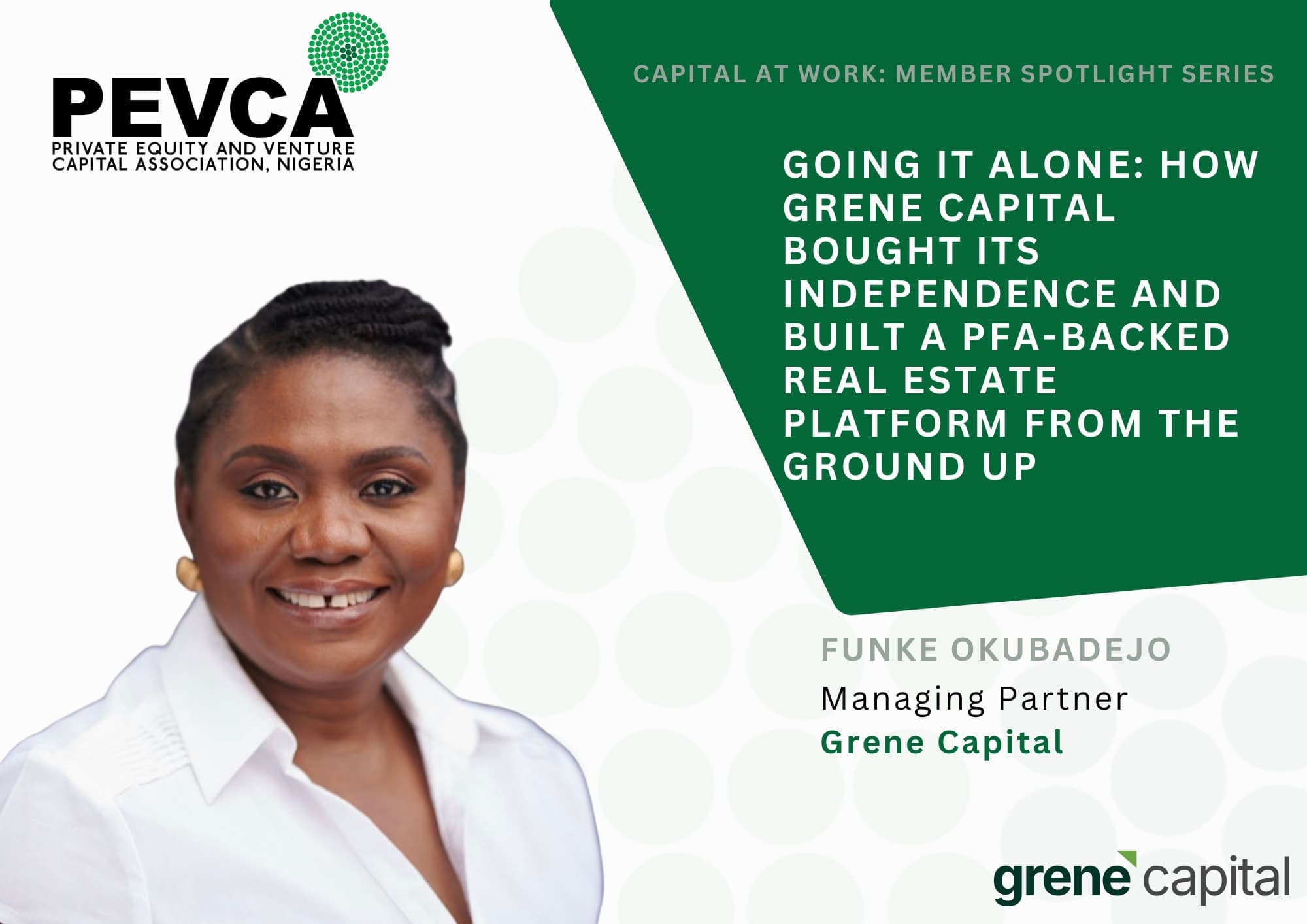
In this edition of Capital at Work, we turn to Grene Capital — and a decision that is still rare in Nigeria's private capital market.
In 2026, Grene Capital completed a management buyout from Actis, becoming a fully independent, Nigeria-headquartered real asset fund manager with $82 million in AUM. The firm manages a closed-end real estate fund with investments in Jabi Lake Mall in Abuja and Heritage Place in Ikoyi — assets built and owned from inception inside Actis, which the team had managed since the fund's creation. They did not inherit a fund. They built it, proved it, and then made the decision to own it. Nigerian pension funds were already committed investors before the buyout, and are seen as strategic partners for future funds and products.
In this feature, Funke Okubadejo, Managing Partner of Grene Capital, reflects on what the decision to go independent actually required — in conviction, in regulatory navigation through SEC and FCCPC approval processes, and in the years of trust-building with domestic institutional investors that made PFA participation possible. She also speaks to the structural realities of real estate private equity in Nigeria — what outsiders consistently underestimate, and what Grene Capital can now build that it could not have built inside a global platform.
Read the full interview below:
Q1. You managed this fund from inception inside Actis, built the portfolio, and then led the buyout to take it independent. Walk us through the moment you decided. What made you certain the time was right?
Funke Okubadejo: I have long held a strong conviction in the opportunity for real assets across Africa, driven by the investment gaps and low local institutional participation in this asset class that diversifies portfolios, offers stable yield and inflation protection. For many years, I advocated for greater institutional investment in real assets and was proud to lead the team at Actis that established a pioneering locally anchored real estate fund.
So, when the opportunity for the spinout from Actis emerged, there was no hesitation. By then, we had demonstrated our ability to originate, execute and actively manage yielding real estate investments to institutional standards and built a high-quality portfolio and pipeline of assets.
The spinout was not simply about becoming independent but delivering the proposition at a scale that matches the opportunity.
Q2. Nigerian pension funds are already committed investors, and you see them as strategic partners for your future funds and products. How did you build that relationship, and what did it take to get PFAs comfortable with a locally managed real estate PE fund?
FO: Trust is built over time, and for us it started with listening.
When we first engaged Nigerian pension funds, many were interested in real estate but understandably cautious about private equity structures, governance arrangements, liquidity considerations and execution risk. We invested significant time in understanding those concerns and demonstrating how institutional real estate could generate stable, inflation-resilient income while fitting naturally within their long-term investment objectives
Pension funds are stewards of long-term savings and rightly expect the highest standards of governance, transparency, risk management and fiduciary oversight alongside strong investment performance.
Over time, confidence was earned through execution. Investors could see the quality of the assets, the discipline of the investment approach and the consistency of performance through market cycles.
Today, we see pension funds not just as investors but as strategic partners in deepening capital markets and channelling long-term capital into real estate, infrastructure, alongside other productive sectors across Africa.
Q3. Jabi Lake Mall and Heritage Place are assets that ordinary Nigerians interact with daily. How does that ground-level visibility shape how you think about asset management and how you're accountable to your investors?
FO: It creates a unique level of accountability.
Operational excellence and investment performance are tightly aligned. When thousands of people interact with your assets every day, whether they are shopping, working, visiting tenants or simply passing through, the quality of their experience directly influences occupancy, tenant retention, reputation and ultimately investor returns.
That is why we focus relentlessly on asset quality, tenant strength, operational efficiency and user experience. Well-managed assets attract stronger tenants, generate more resilient cash flows and perform better through economic cycles.
Ultimately, the interests of tenants, visitors, communities and investors are far more connected than many people realise. A well-managed asset creates value for all of them simultaneously, and that alignment sits at the heart of our asset management philosophy.
Q4. Real estate private equity in Nigeria sits at the intersection of forex risk, construction cost inflation, energy costs, and tenant pressures. What’s the hardest thing about this market that outsiders consistently underestimate?
FO: What outsiders often underestimate is the complexity of operating in an environment where multiple variables can shift at the same time. Success therefore depends more on building resilience at both the asset and portfolio level. Asset quality, tenant strength, cost control and active asset management, including risk management and use of contractual protections, are critical.
Generating stable long-term returns often comes from disciplined management of high-quality income-producing assets, preserving occupancy, managing costs, improving operational performance, and protecting cash flows through different economic cycles.
The challenge is not simply acquiring good, well-priced assets. It is also in creating and preserving value every day. That is where deep local knowledge, disciplined execution and hands-on asset management make the difference.
Q5. You’re now fully independent. What can Grene Capital do today that it couldn’t do inside a global platform, and what’s the first big thing you plan to build with that freedom?
FO: Independence gives us the ability to be more agile and entrepreneurial.
As an independent firm, every decision we make is centred on our investors and our conviction in Africa's long-term growth story. We can move faster; design products tailored to local and international institutional investors with an African mandate and pursue opportunities that may not fit neatly within a larger global mandate.
Our ambition is clear: to build one of Africa's leading real assets investment platforms by connecting institutional capital with high-quality real assets.
The opportunity across the continent is substantial, and we believe the combination of local expertise, institutional discipline and long-term partnerships positions us well to help shape the next phase of real assets investing in Africa.
Quick Takes:
Recent Read: Sapiens - A Brief History of Humankind by Yuval Noah Hariri
Favourite Local Spot: – Anywhere close to nature, especially with plants and trees. I find this really refreshing.
One word for 2026: Evolve
Published on 2026-09-09