African Capital for African Opportunities: How Kuramo Capital Is Reinventing Its Model — and Why Now
2026-09-09
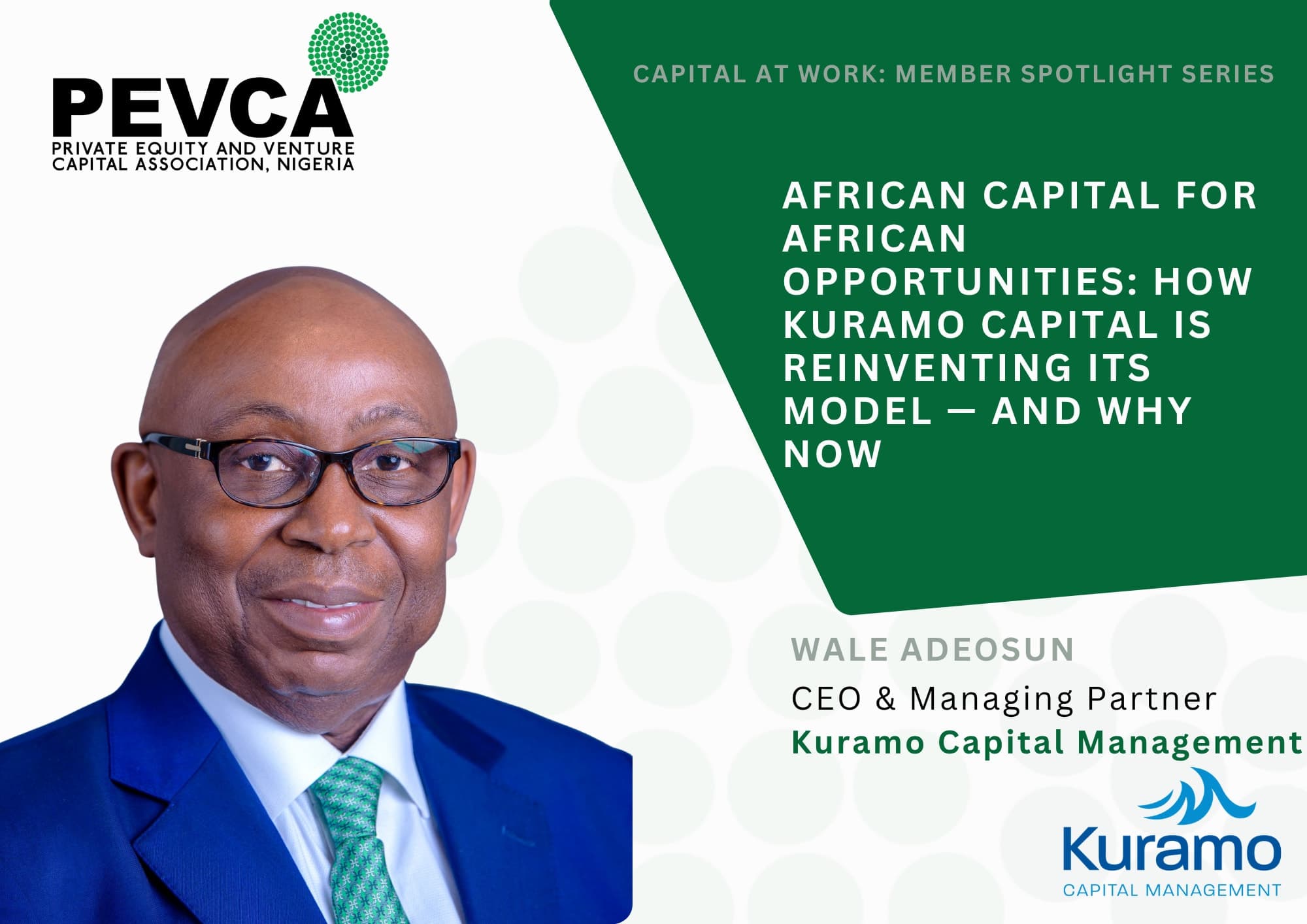
In this edition of Capital at Work, we turn to Kuramo Capital at a pivotal moment in the firm's evolution.
For fifteen years, Kuramo built its track record mobilising capital from Western endowments, foundations, and family offices into African private equity. In 2026, the firm signalled a deliberate shift. The announcement of approximately $500 million closed from African pension funds and DFIs — alongside the launch of the Kuramo Investment Platform and the DICE Fund of Funds mandate from the Bank of Industry — marked the beginning of a new chapter: African capital, deployed into African opportunities, through a model that now combines fund-of-funds mandates with direct investments.
In this feature, Wale Adeosun, CEO and Managing Partner at Kuramo Capital, reflects on what is driving the firm's strategic evolution, what it actually took to build the institutional relationships needed to raise $500 million from African LPs, and what managing the DICE mandate — one of the largest government-backed tech investment programmes in African history — requires of a new fund manager. He also speaks candidly about the biggest misconception global LPs still hold about Nigeria, and why he believes the next chapter of African private equity will be written in local currency, by local institutions.
Read the interview below.
Q1. Kuramo just announced the closing of approximately $500 million from African pension funds and DFIs and the launch of your Investment Platform. That's a significant evolution from the traditional fund-of-funds model. What is driving that shift, and what does it mean for how Kuramo operates going forward?
Wale Adeosun: Our Investment Platform is really the natural evolution of what we have been building for the past 15 years. Kuramo started by mobilising global institutional capital into Africa and backing talented indigenous fund managers and businesses. The focus on supporting first-time indigenous fund managers emanated from a White Paper we wrote on the Private Equity ecosystem. We concluded that the opportunity was supporting indigenous first-time managers on the ground focused on value-creation for SMEs. Today, we have since catalysed more than $3.5 billion into African private equity firms and businesses.
Our updated research of the private equity ecosystem in recent years revealed the opportunity being missed from not investing enough in women-led businesses and signs of a shift in funding sources due to global fragmentation as well as inward focus by the early group of capital providers to Africa. This led to our next chapter of developing a Gender Lens Investment (GLI) approach to increase the numbers of first-time women-led fund managers and increase focus on African capital backing African opportunities. Recent geopolitical events have confirmed the inward focus of funders.
Our Investment Platform announcement of $500 million consolidates our existing GLI ABCD approach: Accelerator, Bridge, Catalyse, and Develop under Moremi Capital
Management, which has identified 45 women-led funds that have raised over $100 million, the Wholesale Impact Investment Fund (WIIF), the Investment in Digital and Creative
Enterprises (iDICE) and mandates from African pension funds and DFIs demonstrating that local institutional capital exists and can play a much bigger role in financing the continent’s growth.
For Kuramo, going forward, we will continue evaluating our ecosystem to develop pioneering solutions using our experience, networks and investment infrastructure to catalyse capital to African businesses utilising both funds and direct investments.
Q2. The iDICE programme has been in the works for years. Nigeria's first direct government investment into a private VC fund only happened in November 2025. How significant is this milestone for the ecosystem?
WA: iDICE is an extremely significant milestone for the ecosystem because it creates a precedent. Governments do not have to build every solution themselves; they can use professionally managed private investment structures to catalyse industries.
Nigeria’s digital and creative sectors have extraordinary talent but remain undercapitalised. iDICE creates an institutional framework through which public capital can crowd in private
capital and support entrepreneurs at scale.
If executed successfully, the importance goes beyond iDICE. It demonstrates a model that can be replicated across other sectors.
Q3. You're mandated to raise matching private-sector capital dollar for dollar. In a market where institutional investors are still cautious about alternatives, how realistic is that target — and what's your plan to get there?
WA: Yes, we are mandated to raise matching funds. It is an ambitious target but realistic. iDICE exists to catalyse capital into the local venture ecosystem. If we deployed the government's money and nothing came alongside it, we would have failed the mandate even if the returns were perfectly
respectable.
The way we're structuring it matters here. We're building the fund with two buckets. One is genuinely catalytic — capital for early-stage, first-time fund managers, the people who cannot get a hearing offshore and for whom our cheque is the difference between a fund existing and not existing. The other is for more experienced managers. And what we're finding in that second bucket is that the experienced funds have already demonstrated the ability to match. They're in market, they have live LP conversations, they bring their own investors. Our capital plays a catalytic role in facilitating some of those existing LP conversations, getting them across the line to a close. We're not asking the industry for a change of heart — we're coming alongside managers who are already closing.
Q4. Kuramo now has both fund-of-funds mandates and a growing direct investment portfolio through the Investment Platform. How do you decide when to back a fund manager versus going direct — and what does the right deal look like in each case?
WA: It's less of a judgment call than the question implies. We run separate products, and each one has its own investment mandate. So, the decision is effectively made when the capital is raised, not deal by deal. A dollar that comes in through the iDICE mandate is fund-of-funds money — it isn't available to go direct, and the reverse is equally true. When you manage other people's mandates, that discipline is not optional.
While there are nuances when we decide to back a fund manager versus going direct, our work is fundamentally a people business. We are in the business of identifying fund managers or entrepreneurs with integrity, strong local networks, and growing businesses where we can add value that can generate attractive risk-adjusted returns for our investors.
We back fund managers when they have differentiated local expertise, strong alignment and the ability to build a scalable institutional platform. Our history of backing emerging
managers has shown us how powerful that model can be.
We invest directly where our knowledge, networks and capital can materially accelerate a strong business. In both cases, we look for capable leadership, governance, scalability, and
a clear path to value creation.
Q5. You've spent your career building bridges between global capital and African private equity. What's the single biggest misconception that global LPs still hold about investing in Nigeria, and how do you push back on it?
WA: The biggest misconception is that risk in Nigeria automatically means poor risk-adjusted returns. Nigeria is complex, but complexity also creates opportunity. Investors often focus
on macroeconomic volatility without sufficiently recognising the depth of entrepreneurial talent, market size and unmet demand. Thankfully, the risk perception of Nigeria continues to improve, and the associated risk premium is starting to decline thanks to the Creative Arts sector, particularly our Afrobeats stars.
Additionally, we push back with evidence. After 15 years of investing across Africa, we know that local knowledge, disciplined underwriting, strong governance and patience matter enormously. The question should not be, “Is Nigeria risky?” Every market has risk. The better question is, “Do you understand the risk well enough to price it and find the
opportunity within it?”
QUICK TAKES
Recent Read: The Prosperity Paradox by Clayton Christensen, Efosa Ojomo and Karen Dillon. A compelling reminder that some of the greatest opportunities for investment and impact are found where others see complexity and constraint. I am always drawn to ideas that challenge conventional thinking around leadership, investing and Africa’s economic transformation.
Favourite Local Spot: Pitstop Village - A place I enjoy for its Jazz music, energy, conversations and the opportunity to step away and reflect.
One Word for 2026: Momentum. We are seeing African capital, talent and institutions increasingly taking ownership of the continent’s investment story. The opportunity now is to build on that momentum.
Published on 2026-09-09