Reading the Fine Print: How DOA Is Advising Clients Through the Most Significant Shift in Nigeria’s Private Capital Legal Landscape in a Decade
2026-09-09
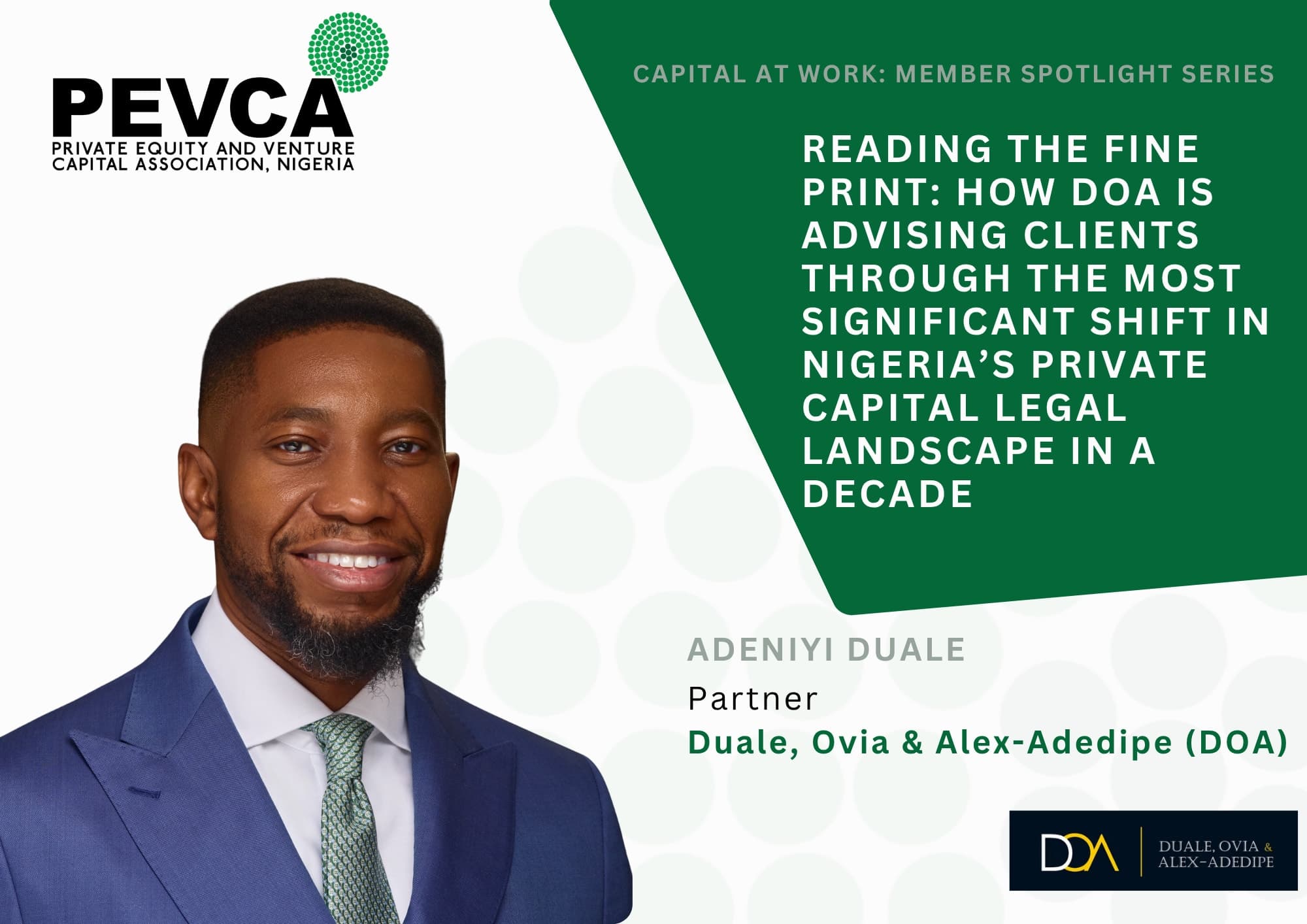
In this edition of Capital at Work, we turn to Duale, Ovia & Alex-Adedipe — and to the legal infrastructure that sits beneath every private capital transaction in Nigeria right now.
The ISA 2025 and the Nigerian Tax Reform Acts together represent the most significant shift in Nigeria's private capital legal landscape in a decade. The ISA has formally brought PE and VC funds inside the collective investment scheme framework, closing a grey area that left closed-ended funds without regulatory clarity for years — but introducing new compliance obligations in its place. The Tax Reform Acts have introduced indirect capital gains taxation that changes how offshore disposals are structured, priced, and indemnified. DOA has been advising clients in real time, on live transactions, as the rules have taken effect.
In this feature, Adeniyi Duale, Partner at DOA, speaks plainly about what these changes mean in practice. From the ISA 2025's compliance implications for fund managers navigating CIS registration and disclosure obligations, to a concrete scenario where a 30% capital gains tax liability changes the economics of an M&A transaction, to what it actually takes to bridge the gap when a GP and a founder cannot agree across a deal table — this is the conversation practitioners are having privately. DOA is having it on the record.
Read the full interview below:
Q1. You advise both fund managers and founders on deal structuring. When a GP and a founder sit across the table, where does the negotiation most commonly break down — and what is your role in bridging that?
Adeniyi Duale: In my experience, negotiations usually break down around governance rights, board composition, and distribution rights. Understandably, GPs want enough control to protect their investment, while founders want the flexibility to run the business without approval for every decision. The real issue is typically a gap in understanding of market practice.
Where both sides are experienced, those tensions are usually manageable because everyone understands the commercial rationale behind those terms. It is usually more complex when you are dealing with a party that is less experienced with market practices or taking on investors, because everything becomes negotiable. In instances like that, my role becomes less about negotiating positions and more about translation, basically helping the investor secure the protections they genuinely need and helping the less experienced party understand what's market-standard versus what’s actually worth pushing back on. Ultimately, my duty is always to my client, but the best deals are usually the ones where both sides understand each other's concerns and leave the table feeling like they have been heard.
Q2. The Nigerian Tax Reform Acts have real implications for how M&A transactions are priced and structured. Can you walk us through a scenario — even a hypothetical one — where the tax treatment under the new framework meaningfully changes the economics of a deal?
AD: Yes, notably, the newly introduced indirect taxation of capital gains.
For example, if an offshore company disposes of its shares, and (a) more than 50% of such offshore company's value comes from Nigerian assets during the last 365 days preceding the disposal; or (b) the sale indirectly changes ownership of a Nigerian company/asset, such disposal may now be liable to a 30% Nigerian capital gains tax ("CGT"). Thus, parties must assess valuation early, determine the applicable CGT treatment, and factor that risk into the deal, whether by rethinking tax indemnities or structuring earn-outs around it, or through other applicable mitigation techniques.
Q3. The ISA 2025 has brought PE and VC funds formally under Nigeria’s collective investment scheme framework. You’re advising clients on deals being structured under this new regime right now. What’s the most significant practical change it has introduced — and where is it creating more complexity rather than less?
AD: The most significant practical change is that PE and VC funds are now formally inside Nigeria’s CIS regime pursuant to Sections 150 and 151, which closed a gap that left closed-ended funds in a grey area under the previous Act. Where it gets more complicated is the compliance obligations resulting from the certainty. PE and VC funds now have to navigate CIS registration, disclosure obligations and stiffer penalties for default.
Q4. DOA has built a reputation specifically in private capital — PE, VC, M&A. That is a deliberate positioning choice in a market where many law firms try to be generalists. What has that focus required of the firm, and what would you tell a young lawyer who wants to build a career at this intersection?
AD: I would say that DOA has been deliberate with our PE, VC, and M&A practice, but you will find that same intentionality across our practice areas. This positioning has required investing in people who think commercially, not just technically, because on a live deal, clients aren’t only looking for the correct legal answer; they want advisers who understand the transaction, the commercial drivers behind it, and what it actually takes to get the deal across the line. It has also meant staying close to how these markets move.
For a young lawyer looking to build a career at this intersection, my advice is simple: get comfortable being commercially minded, read up on the deals happening in the market, not just statutes. Find people who do this work every day and learn from them directly. And be patient; depth in this area takes time to build, and it's earned deal by deal, not overnight. If that's the kind of work that excites you, we are always looking for good people to join the team.
Quick Takes:
Recent Read: Soldiers of Fortune: A History of Nigeria (1983-1993). It is a book that talks about the history of Nigerian Politics between 1983 and 1993 (From Buhari to Babangida). Reading this book gave me a greater perspective on the history of some of our leaders.
Favourite Local Spot: Lagos JetSki Club
One word for 2026: Grateful
Published on 2026-09-09