Two Funds, One Bet: How Sahel Capital Is Building Nigeria's Agribusiness Capital Stack
2026-06-24
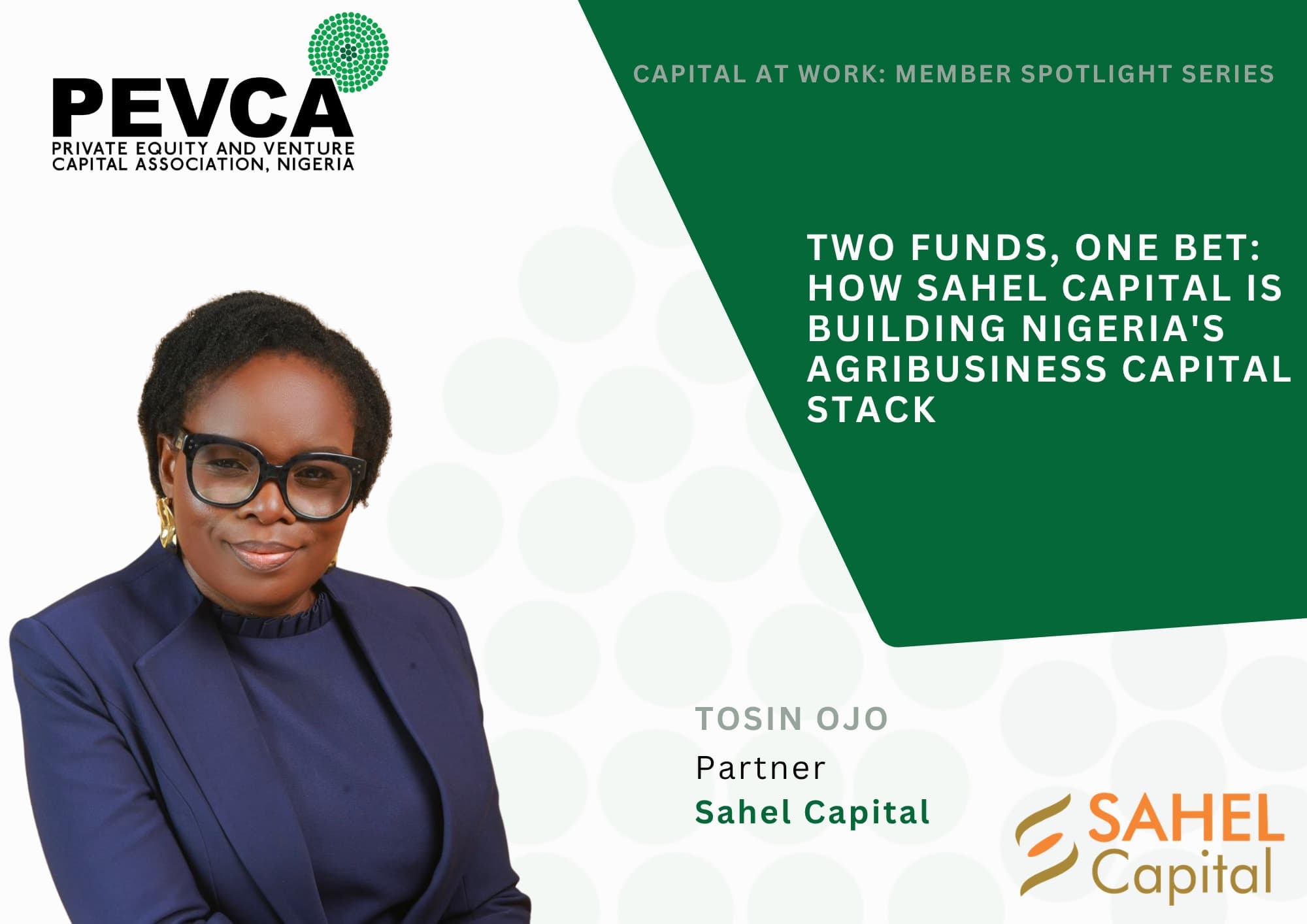
In this edition of Capital at Work: PEVCA Member Spotlight Series, we turn to Sahel Capital, which is executing one of the most structurally sophisticated capital strategies in Nigeria's private markets today: running a dollar-denominated blended equity fund and a naira-denominated private debt fund simultaneously. The SCAF II first close, anchored by a European DFI, and the launch of the ₦75 billion Sahel Agribusiness Private Debt Fund represent two sides of the same conviction — that Nigeria's agribusiness sector needs patient capital across the full stack, not just at the top.
In this feature, Tosin Ojo, Partner at Sahel Capital, unpacks the logic behind the dual-track approach, what the firm learned from building and exiting FAFIN, and where she believes the real financing gaps lie in Nigeria's agribusiness value chain. She also speaks candidly about what is holding domestic institutional capital back — and what it will take to move pension funds and insurers into alternatives at the scale the ecosystem needs.
Read the interview below:
1. You are running a dollar equity fund and a naira debt fund simultaneously. What is the thesis that connects them, and why launch both at the same time rather than sequentially?
Tosin Ojo: We run two strategies — debt and equity — because agribusiness companies need both at different life stages, and few institutions structure around agri-value-chain cash flows well. Each strategy has a dollar and naira vehicle: the equity fund is two co-investing parallel vehicles, while the debt fund's offshore and naira vehicles invest independently. The naira products matter because Africa's private markets future is local currency — FX volatility adds a burden international peers don't carry. Long-term, the most stable capital will be domestic institutional capital. The dollar equity fund had to launch as linked vehicles; the naira debt fund launched separately when the opportunity was right — we've since raised 55% of the target from six pension funds.
2. Blended finance structures are often discussed but rarely executed well in Nigeria. What did you learn from FAFIN that you are doing fundamentally differently with SCAF II?
T.O: FAFIN had one equity class, funded by the Nigerian government through MOFI, and European DFIs — but investors with different risk-return appetites weren't well served by a single structure. SCAF II fixes that with two equity classes: a junior, first-loss tranche from a European DFI, and a senior tranche from investors, including a U.S. family office and domestic financial institutions in Nigeria. This lets impact-first investors and return-first investors each get what they need from the same fund — a structure FAFIN's flat cap table didn't allow.
3. The ₦75 billion Sahel Agribusiness Private Debt Fund specifically targets Nigerian pension funds and insurance companies. How ready is that institutional base, and what still needs to change before local capital reliably flows into alternatives at scale?
T.O: We set out to raise ₦25 billion for Series 1 of the debt fund and closed at 55% — entirely from pension funds. The level of interest surprised me. It came down to specialisation: 15 years of sector experience, across debt and equity, gave PFAs confidence we understood the risks. PFAs want differentiation — exposure they can't get from public markets — and they're fee-sensitive, so managers need to justify costs against that. They're also rigorous: expect deep diligence, real pipeline evidence, not just a pitch deck. They are ready to commit, but what's missing is more specialised fund managers bringing genuinely differentiated products. Fundraising is never easy, but strong strategy and delivery become self-reinforcing.
4. Agriculture is central to Nigeria's food security and employment, yet the private capital financing gap is estimated at $180M annually. Why has private equity been slow to move in at scale, and what has changed?
T.O: This is partly a lecture, but here's the short version: agriculture isn't one thing — it's a complex system of interconnected economic activities, from production through processing, storage, distribution, and retail. Fix one part without fixing the others, and your investment often fails for reasons that look like sector risk but are really supply chain breaks. It also takes 10-15 years to build a solid agribusiness at scale, while private equity is structured around 5-7 year exits — a fundamental mismatch.
What's changing: PenCom's updated guidelines now recognise agribusiness funds as a distinct asset class within private funds — a meaningful policy shift likely to draw new entrants and new agri-focused funds. The challenge will be credibility: this is a sector where experience compounds as a genuine competitive advantage, so first-time managers will have real ground to make up.
5. Of the value chain segments you are backing — cold chain, input supply, last-mile distribution — which is most structurally broken, and where is the real money being left on the table?
T.O: The cold chain is where the most value is being lost. Infrastructure exists, but it's fragmented — frozen chicken producers and dairy companies have each built their own facilities, mostly underused, sitting as stranded capacity rather than shared infrastructure. An organised, shared cold-chain-as-a-service model would unlock significant productivity gains, particularly for perishables. It's a hard problem to solve because the cold chain depends on steady, affordable electricity, and Nigeria's energy costs and reliability remain a real constraint. But the opportunity sitting in underused capacity alone is substantial.
Quick Takes:
A short human-interest close. Please provide brief responses to the following:
- Recent Read: [Book, article, or podcast]
A favourite book I’ve read: The Hard Thing About Hard Things by Ben Horowitz
- Favourite Local Spot: [A restaurant, café, or place]
Favourite local spot: Most waterfront (lagoon front) bars in Lekki 1 or VI. Staying on the waterfront is how I decompress for a few hours once a week in the evenings. Or sometimes jogging over the bridge to see the waterfront
- One Word for 2026:[Your mood or mindset for the year]
“Possibilities”
Published on 2026-06-24