26x and Counting: Inside Aruwa Capital's Case for Gender-Smart Investing
2026-06-22
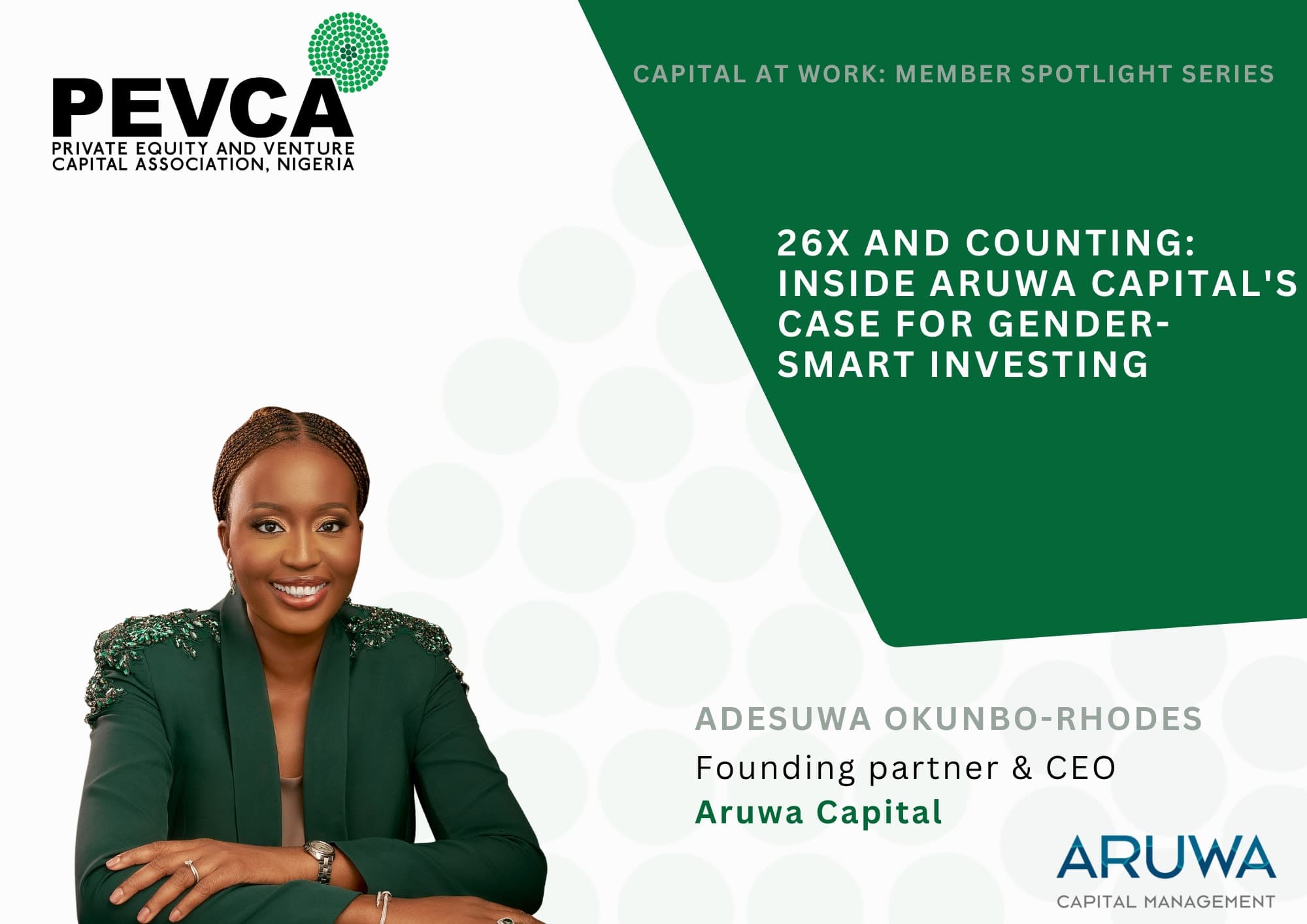
In this edition of Capital at Work: PEVCA Member Spotlight Series, we turn to Aruwa Capital, whose Fund II has reached 90% of its $40 million target with a landmark first: the Bank of Industry — Nigeria's oldest and largest development finance institution — joining as a first-time LP. The milestone signals a meaningful shift in how domestic institutional capital is beginning to engage with locally-based private equity managers.
In this feature, Adesuwa Okunbo Rhodes, Founder and Managing Partner at Aruwa Capital, reflects on what it took to build LP conviction from scratch, how Fund I's portfolio companies achieved 26× revenue growth in local currency through one of the most turbulent macroeconomic periods in recent memory, and why she believes gender-lens investing is a rigorous investment discipline — not a trade-off. She also offers an unflinching view of what the Nigerian PE ecosystem still needs to build, structurally and culturally, before it can fully absorb the capital it is trying to attract.
Read the interview below:
1. The Bank of Industry joining Fund II as a first-time LP is a significant milestone. How hard was that relationship to build, and what does it signal about where domestic institutional capital sits in its understanding of private equity?
Adesuwa Okunbo-Rhodes: This was not an overnight relationship. Our engagement with the Bank of Industry dates back to Fund I, and over time, we built credibility through consistent execution, transparency, and measurable outcomes. As our portfolio companies scaled, we demonstrated not only strong commercial performance but also meaningful job creation and economic impact.
A key proof point was seeing several Fund I portfolio companies subsequently access BOI financing. This highlighted the natural synergy between our organisations, with private equity and development finance supporting business growth at different stages. BOI's commitment to Fund II signals a broader evolution in how domestic institutional capital views private equity. There is growing recognition that, with strong governance and a proven track record, private equity can drive business growth, job creation, and attractive risk-adjusted returns.
2. Your Fund I portfolio companies have grown revenues by an average of 26x in local currency since investment, through a period of significant naira devaluation and compressed consumer spending. What is actually driving that, and how replicable is it in Fund II?
AOR: The growth reflects genuine operating expansion, not just inflation or currency effects. A key driver was our focus on businesses addressing essential needs, including healthcare, consumer goods, and financial services, combined with strong execution, distribution, and disciplined unit economics.
Import substitution was also a significant factor. Several of our portfolio companies, including manufacturers such as Wemy Industries, Fastizers, and Taeillo, were well-positioned to benefit from naira depreciation as consumers and businesses increasingly shifted towards locally produced alternatives. This enabled them to capture market share while reducing exposure to imported inputs.
While naira devaluation contributed to local currency revenue growth, the underlying story was one of increased customer adoption, stronger market positioning, and operational resilience. These are the same characteristics we are targeting in Fund II, with an even greater emphasis on scalability, margin resilience, and businesses that can thrive in challenging macroeconomic environments.
3. Gender-lens investing is still treated as a niche or an impact trade-off by many mainstream LPs. What is the most frustrating misconception you encounter, and what data do you use to push back?
AOR: The most persistent misconception is that gender-lens investing requires a trade-off on returns. That is not supported by our experience. Our data shows that around 70% of our portfolio companies are female-founded or female-led, and these businesses have delivered on average 26x revenue growth and 7x valuation uplifts from subsequent rounds since our initial investment. This is not an impact outcome separate from financial performance; it is the financial performance.
We also see that diverse leadership strengthens governance, improves capital efficiency, and sharpens market understanding, particularly in consumer-facing sectors where women are often closer to purchasing decisions. We push back with evidence from realised outcomes across our portfolio. Over time, the conversation shifts from viewing gender-lens investing as a niche strategy to recognising it as a commercially sound investment approach that consistently delivers strong, scalable returns.
4. You are raising in one of the hardest fundraising environments in a decade. Be honest, what is the LP objection that has been hardest to answer, and how have you handled it?
AOR: The most difficult objections have centred on liquidity and exit timelines, and, in some cases, on being a solo GP. LPs are rightly focused on DPI, particularly in markets where exits are less predictable, and timelines can extend.
We address this by being very explicit about how we underwrite exits from the point of entry, prioritising businesses with clear strategic or trade sale pathways, regional buyer interest, and strong fundamentals that make them attractive acquisition targets over time. We also lean on evidence from Fund I, where we have realised several partial exits and have full exits in progress. This has been made possible through disciplined portfolio construction and active value creation.
Regarding the solo GP concern, we have built depth in the investment and portfolio teams and strengthened our institutional backbone by appointing a Head of ESG and a Head of Finance. Ultimately, it comes down to building trust over several years where investors gain confidence in you and the team's execution.
5. What does a healthy Nigerian private capital ecosystem look like in 2030, and what is the one policy or structural change that would most accelerate getting there?
AOR: A healthy ecosystem in 2030 would have more women running and managing funds, deeper domestic institutional participation, more predictable exit routes, and a stronger base of scalable companies able to raise and recycle capital locally and regionally. It would also reflect better data transparency and more coordinated alignment between public policy and private capital formation. The single most catalytic change would be unlocking significantly more pension fund capital into private equity and venture, under clear, risk-adjusted frameworks. That shift alone would deepen local liquidity, reduce overreliance on offshore capital, and strengthen long-term capital formation in Nigeria.
Quick Takes:
- Recent Read: [Book, article, or podcast]
I was recently gifted Who by Geoff Smart and Randy Street. It focuses on the “secret sauce” to hiring the right people and building strong teams, which feels especially relevant given our rapid expansion. It was a timely and practical read, and one of the most useful books I’ve come across this year in thinking more deliberately about talent and organisational growth.
- Favourite Local Spot: [Restaurant, café, or place that inspires you]
RSVP Restaurant- The food never disappoints, and I love the vibrant atmosphere it consistently delivers. It’s one of those places that effortlessly brings people together - warm, lively, and perfect for good conversation.
- One Word for 2026: [Your mood or mindset for the year]
Velocity!
Published on 2026-06-22