Verod’s Exit Playbook: Growth, Governance, and a Changing Macroeconomic Outlook
2025-12-09
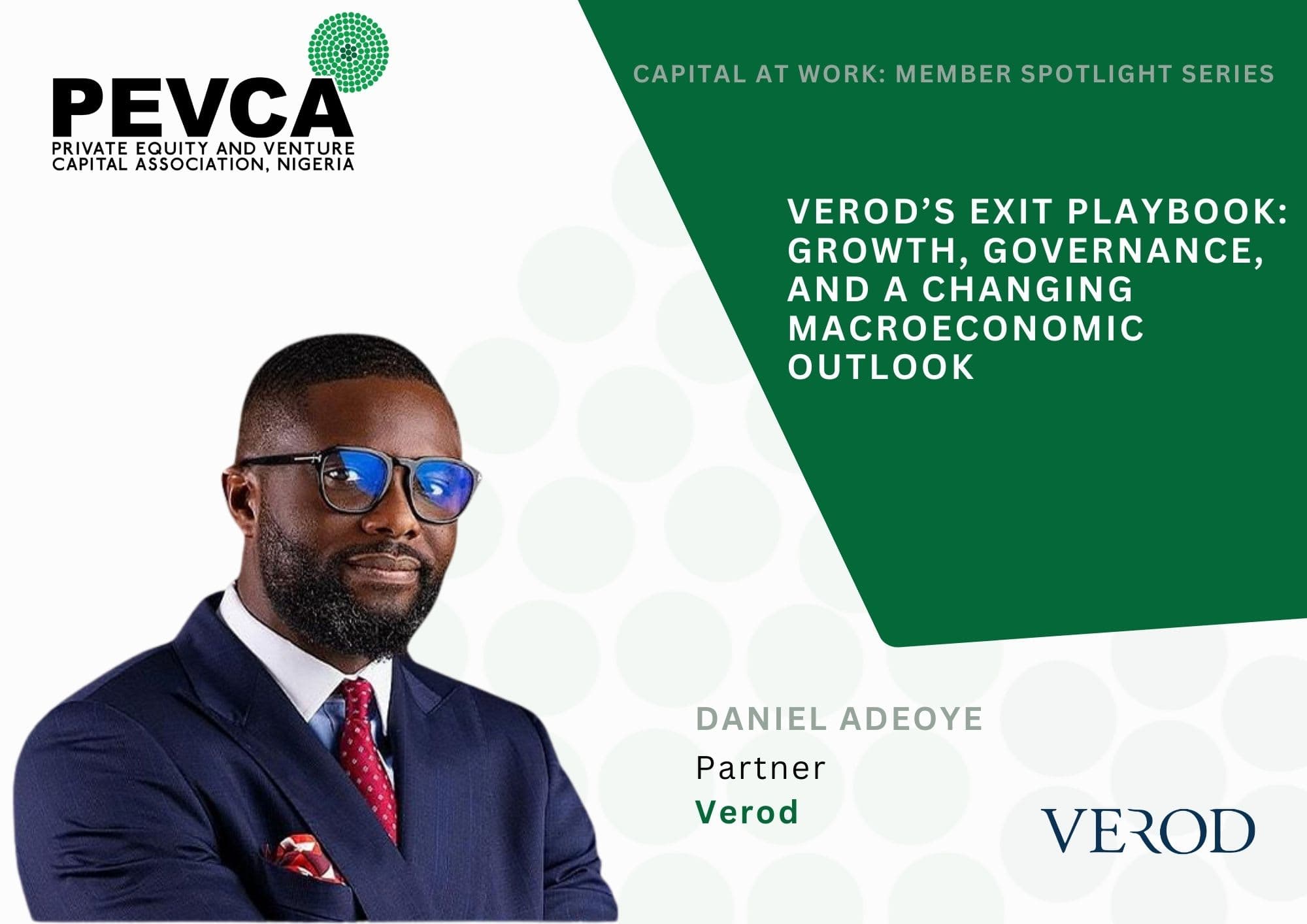
In this edition of the Capital at Work: PEVCA Member Spotlight Series, we turn to Verod Capital, whose recent exit from Tangerine APT Pensions marks both a significant achievement for the firm and a broader signal for Nigeria’s private equity landscape. The transaction — which saw AUM grow from ₦100 billion to over ₦445 billion — highlights what strategic consolidation, operational discipline, and steady governance can unlock in a challenging macroeconomic environment.
In this feature, Daniel Adeoye, Partner at Verod, reflects on the multi-year journey behind the deal: from leading the merger of AXA Mansard Pensions and APT Pension Fund Managers, to driving top-quartile investment returns and strengthening the company’s market position. He shares the strategic levers that shaped the exit, the regulatory and structural headwinds the team navigated, and the lessons the firm is carrying into its next chapter. Daniel also offers a forward view on what needs to evolve — in policy, markets, and investor confidence — for exits to become more commonplace across Nigeria’s private equity sector.
Read the Interview Below:
1: Congratulations on the exit from Tangerine APT Pensions. What does this transaction represent for Verod, and what does it tell us about the evolving exit environment in Nigerian private equity?
Daniel Adeoye: The exit from Tangerine APT Pensions is a significant milestone for us at Verod. It reflects our ability to identify high-growth opportunities, execute against a strategy and deliver solid returns for our investors. All while ensuring the business delivers market-leading impact and ESG standards.
This deal demonstrates that exits are achievable when you combine operational improvements with a clear value creation strategy. With macroeconomic conditions steadily improving – supported by declining inflation and exchange rate reforms – we hope to see the exit environment here continue to strengthen.
2: Verod led the merger of AXA Mansard Pensions and APT Pension Fund Managers into Tangerine APT Pensions, and grew assets under management (AUM) from around ₦100 billion to over ₦445 billion. What were the key strategic levers you pulled to achieve that growth?
DA: We entered the pensions market with a clear thesis: consolidate, optimise and scale. Alongside our partners at APT Securities and Funds, we achieved our thesis by merging the two companies and rebranding the business, focusing on enhancing the merged company’s operations and growing the customer base.
The results demonstrate the power of strategic consolidation. We grew assets under management by four and a half times, delivered top-quartile investment returns and captured significant market share during the transformative transfer window period. Most importantly, we leave Tangerine APT Pensions exceptionally well-positioned for continued growth with a strengthened market position and proven management capabilities.
3: Exits in Africa often face structural and regulatory hurdles. What were the most significant headwinds you navigated in this case — and how did you address them?
DA: We secured approval from Nigeria’s National Pension Commission (PENCOM) upfront during the investment phase – a non-negotiable in the pensions sector. But approval at entry doesn't guarantee smooth sailing at exit.
Throughout the holding period, we maintained continuous engagement with the regulator while ensuring Tangerine APT operated under rigorous governance standards that aligned with PENCOM's expectations. This ensured we built institutional credibility.
By exit, three factors worked in our favour. First, Verod is no longer a new face to PENCOM – established relationships matter. Second, the sale was to minority shareholders rather than an external party, which simplified the regulatory pathway. Third, the company's governance track record gave the regulator confidence in the transition.
The investment cycle underlined to us that regulatory relationships aren't just about approval of checkboxes. They're built through consistent engagement, operational discipline and demonstrated alignment with the regulator's mandate. That groundwork compounds when it's time to exit.
4: From your view, what are the critical conditions (policy, regulatory, market-based) that must be in place for exits to become more commonplace in Nigeria’s private capital ecosystem?
DA: As this deal demonstrates, exits are very much achievable here in Nigeria with the right team working on the right opportunity. However, as with any market, there are conditions that can support a more conducive environment for exits.
Regulatory clarity and consistency are one example – investors need confidence that rules remain stable and enforceable. A more robust local capital market is another, as it can provide alternative routes for exits. Macroeconomic stability has been an additional significant factor in recent years, though we’re starting to see positive changes – inflation is consistently coming down, and interest rates are also falling.
5: Looking ahead, how does this exit shape Verod’s next chapter - in terms of fund strategy, sector focus and investor engagement?
DA: This exit validates the investment approach we take. We identify opportunities with high potential and work hard to execute with consistency, delivering strong returns for our investors and ensuring we contribute positively to the communities we operate in.
The Tangerine APT Pensions experience ensures that, with our forthcoming Fund IV, we will look to back businesses that can cross-sell products and services and leverage operational efficiency. We will also invest in businesses that can withstand downmarket cycles, have sound knowledge of supply chain dynamics, or create demand-driven markets by introducing new technologies and processes.
6: Finally, what gives you the most optimism about the future of the private equity landscape in Nigeria?
DA: On a macro level, 2025 has given investors in Nigeria huge cause for optimism. The Central Bank of Nigeria has introduced reforms that are restoring investor confidence and stabilising the naira. They have cleared a $7 billion foreign exchange backlog and have taken steps to make the foreign exchange market more transparent. Meanwhile, inflation is continuing to come down – it was 16.05% in October 2025, its lowest level for around three years, having peaked around 34.8% in December 2024.
Nigeria’s policy changes received the seal of approval from the S&P Global Ratings, which recently revised its outlook on Nigeria to ‘positive’ from ‘stable’, saying that reforms would ‘yield positive benefits over the medium term.’
This improving macro environment in Nigeria can reduce perceived risk, attract more international investment and lower borrowing costs for portfolio companies. This is what makes me optimistic for the future.
Quick Takes:
- Recent Read (Book, article, or podcast):
Breakneck: China's Quest to Engineer the Future by Dan Wang
- Favourite Local Spot (Restaurant, café, or place that inspires you):
Ikoyi Club 1938 - Badminton Section
- One Word for 2025 (Your mood or mindset for the year):
“Anagkazo and Phronesis” - the compelling necessity to act, guided by practical wisdom
Published on 2025-12-09